
Agentic Workflows for Beginners: Why They Matter and How They Actually Work
A simple guide to the new way of building useful AI systems without getting lost in the jargon

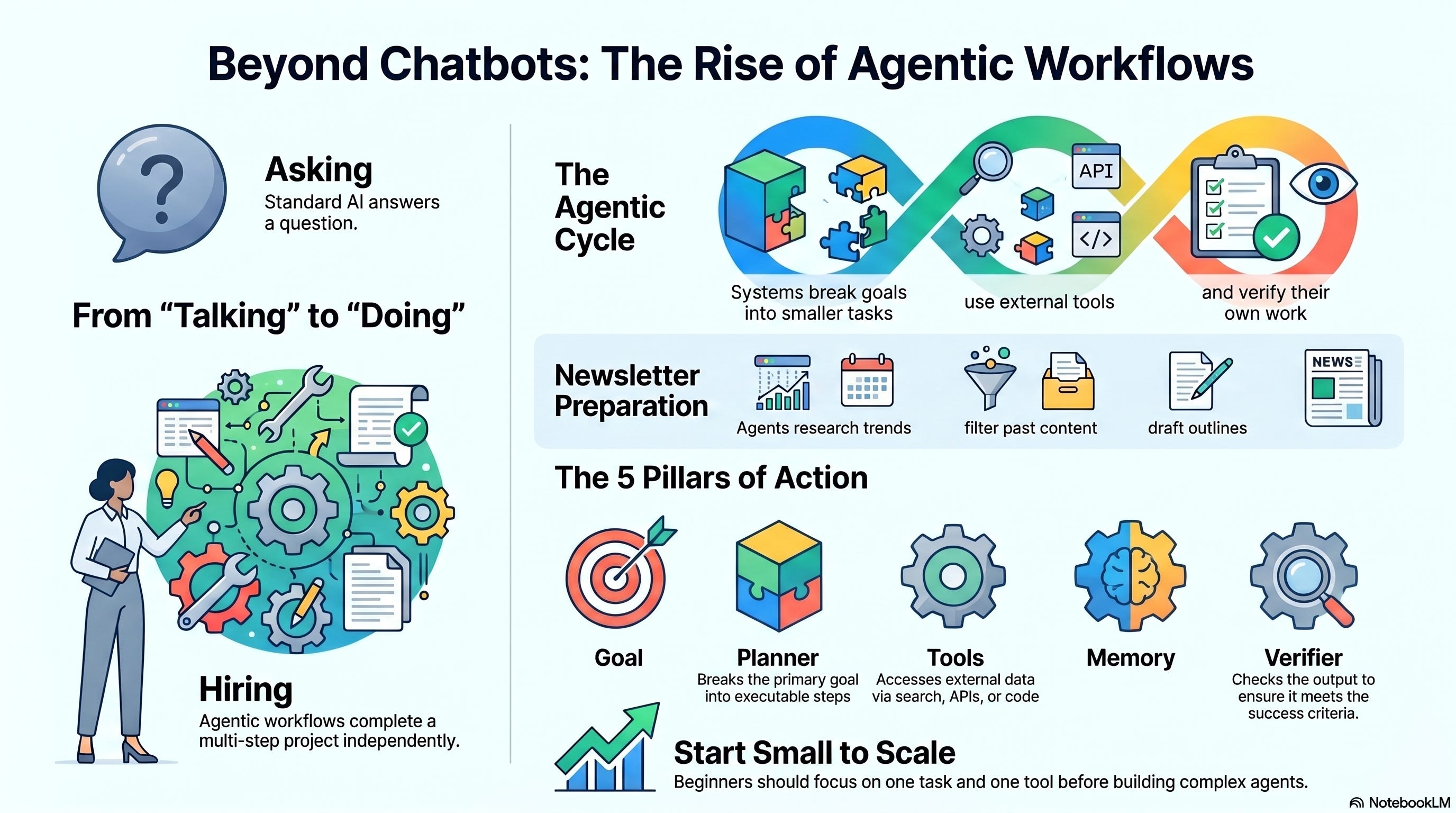
AI is moving from chatbots that answer questions to systems that can actually do things. That shift is why people keep talking about agentic workflows. The idea sounds technical, but the core is simple: instead of asking a model to respond once, you give it a goal, a set of steps, and the ability to move through those steps in a more organized way.
If you are new to this, do not worry. In this article, I will break the idea down step by step, explain why it matters, and show where it fits in the modern AI stack.
What an agentic workflow is
An agentic workflow is a process in which an AI system is given a task and decides how to complete it by following a sequence of actions.
Instead of one prompt and one answer, the system may:
Think about the request.
Break it into smaller tasks.
Use tools or external data.
Check its own output.
Continue until the goal is complete.
That is the big difference. A regular AI response is like asking someone a question. An agentic workflow is like hiring someone to finish a small project.
Why people care now
People care because simple chat is no longer enough for many real problems. If you want an AI system to summarize documents, search files, compare options, fill in structured fields, or follow repeated business steps, a single prompt often falls short.
Agentic workflows are attractive because they can make AI feel more practical and more useful. They also align with the direction the field is heading: systems that combine reasoning, tool use, memory, and action rather than just text generation.
The basic pieces
A beginner-friendly agentic workflow usually has these parts:
Goal. What the user wants done.
Planner. The part that breaks the task into steps.
Tools. Search, code, databases, files, APIs, or calculators.
Memory or context. Information the system keeps in view.
Verifier. A check to make sure the result is reasonable.
If you want to understand it visually, imagine a small assembly line. One-step plans, one-step acts, one-step checks, and then the system moves forward.
A simple example
Suppose you ask an AI system to help you prepare a newsletter idea.
A non-agentic system may just suggest one topic.
An agentic workflow may:
Look at recent trends.
Compare them with your past content.
Filter out repeated topics.
Suggest three fresh angles.
Rank them by likely audience interest.
Draft a working title and outline.
That is why people see agentic systems as more than just chat. They are closer to a lightweight assistant that can move through a task.
Where beginners should start
If you are new, the best way to think about agentic workflows is not as “fully autonomous AI.” Think of them as structured AI processes. That makes them much easier to understand and build.
Start with one small use case:
research,
summarization,
task routing,
FAQ handling,
or content drafting.
Do not try to build a giant agent on day one. Begin with one task, one tool, and one clear success measure.
Common mistakes
Beginners usually make three mistakes:
They make the workflow too complex too early.
They forget to define the goal clearly.
They trust the output without checking it.
A good agentic workflow is simple, visible, and testable. If you cannot explain each step in plain English, it is probably too complicated.
Simple diagram
Agentic workflow
User goal
   ↓
Planner
   ↓
Task steps
   ↓
Tools / data
   ↓
Verification
   ↓
Final answer
Final thought
Agentic workflows matter because they move AI from “talking” to “doing.” You do not need to master everything at once. You only need to understand the structure: goal, steps, tools, and checks.
Once that clicks, the rest becomes much easier.