
Building Your Own Agentic AI System
Empowering Autonomous AI to Plan, Act, and Adapt

Introduction
Imagine telling an AI, “Summarize this week’s customer feedback, identify the top three issues, and draft an action plan for the support team”—and it actually does it, end to end.
Quick answer: Building an agentic AI system from scratch requires seven steps: define a clear use case, choose your technical stack, equip the agent with tools, add memory for continuity, implement a planning and control loop, add guardrails and safety controls, and test iteratively. As Engy Fouda explains, the most reliable path is to start with one focused use case, ship an early version, and refine based on real-world behavior—not theoretical architecture.
Key Takeaways:
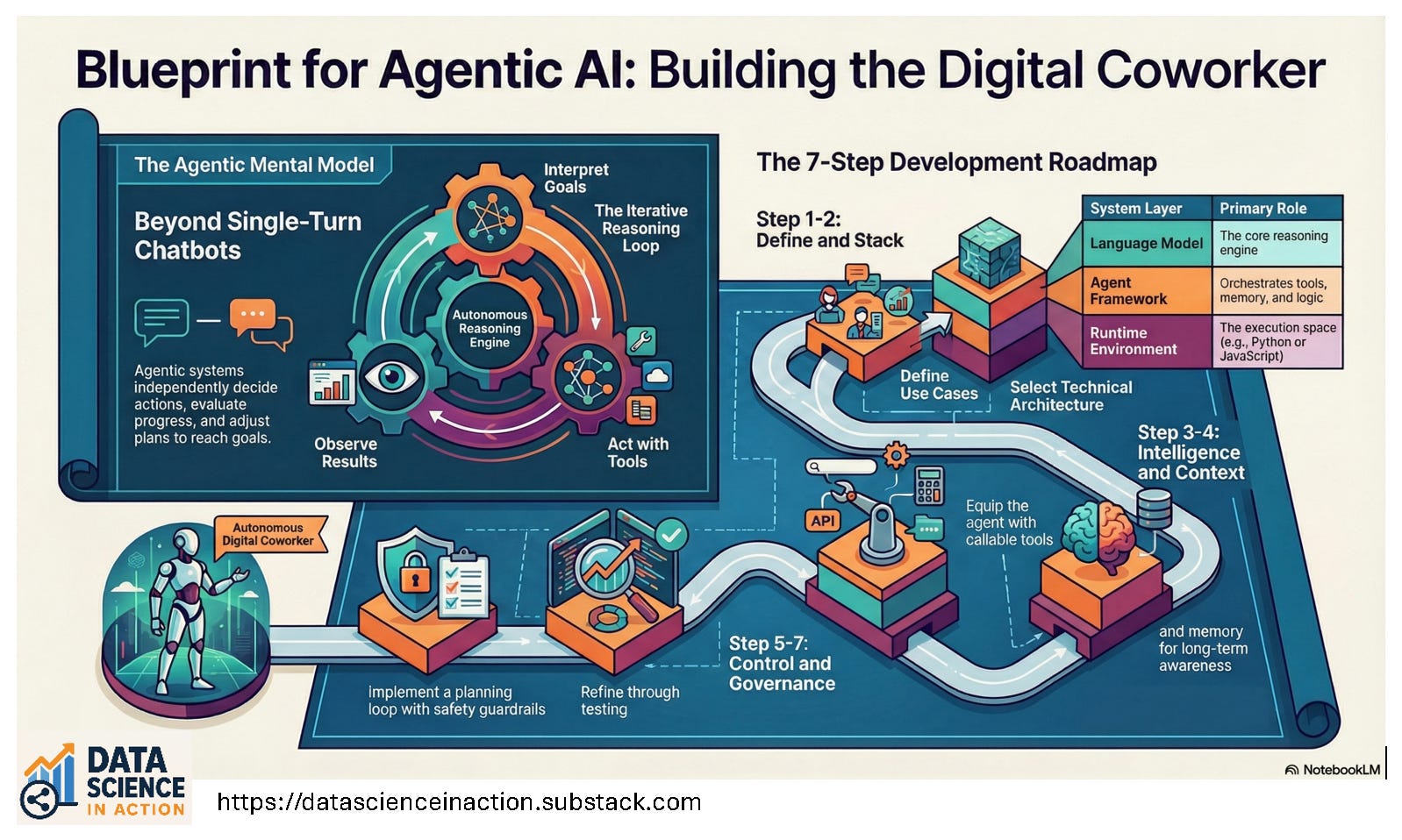
Agentic AI systems operate on a loop: interpret goal → plan → act with tools → observe results → adjust and repeat.
The planning and control loop is the heart of any agentic system; without it, the agent cannot break complex tasks into manageable steps.
Guardrails must be layered at multiple points: input filters, tool argument validation, post-tool validators, and output reviewers.
The fastest path to a working agent is to start with a higher-level framework (LangChain, LangGraph, AutoGen) and replace components with custom code as requirements solidify.
That is the promise of agentic AI: systems that do not just respond once, but can plan, act, and adapt across multiple steps to achieve a goal. Instead of a single‑turn chatbot, you get a digital coworker that uses tools, memory, and iterative reasoning to move work forward.
This article walks through the core concepts and practical steps involved in building your own agentic AI system.
Understanding Agentic AI
Agentic AI is defined by autonomy. It does not just answer a question; it decides what actions to take, evaluates its own progress, and adjusts its plan as needed. These systems combine a large language model with structured components such as tools, memory, and a control loop. The result is an AI that behaves more like a digital worker than a chatbot.
A useful mental model is a loop:
interpret the goal → plan → act with tools → observe results → adjust and repeat.
Step 1: Define a Clear Use Case
Every agent begins with a specific purpose. A well‑defined use case makes the system easier to design, test, and refine. Examples include research assistants, customer‑support agents, analytics copilots, and operational automation tools.
A strong definition includes the expected inputs, the desired outputs, and the actions the agent is allowed to take. For instance, a “support insights analyst” agent might accept support tickets as input, be expected to produce a weekly summary and recommended actions, and be allowed to call tools for database queries, text searches, and email drafts.
