
Part 4–Agents in the Wild (Agentic AI, Tools, Orchestration, and Governance)
Part 4–AI Articles and Tutorials Series

Part 1 decoded the jargon; Parts 2 and 3 walked through RAG and a Colab lab. Part 4 moves one level up: from “a single LLM call” to agents that plan, call tools, collaborate, and require orchestration and governance.


![[Tutorial] Part 3-RAG in Real Life: A Copy‑Paste Colab Lab for Newbies](https://substackcdn.com/image/fetch/$s_!1Kzf!,w_140,h_140,c_fill,f_webp,q_auto:good,fl_progressive:steep,g_auto/https%3A%2F%2Fsubstack-post-media.s3.amazonaws.com%2Fpublic%2Fimages%2F9343dbfb-a1e4-4010-bd50-696b48bfb68d_1590x985.png)
The goal is to build a mental model for:
What an AI agent actually is.
How tools, RAG, and orchestration fit together.
Why “agent sprawl” is a real risk.
What agent governance and observability look like in practice.
1. From one‑shot prompts to agents
A single LLM call is simple:
Input: prompt.
Output: answer.
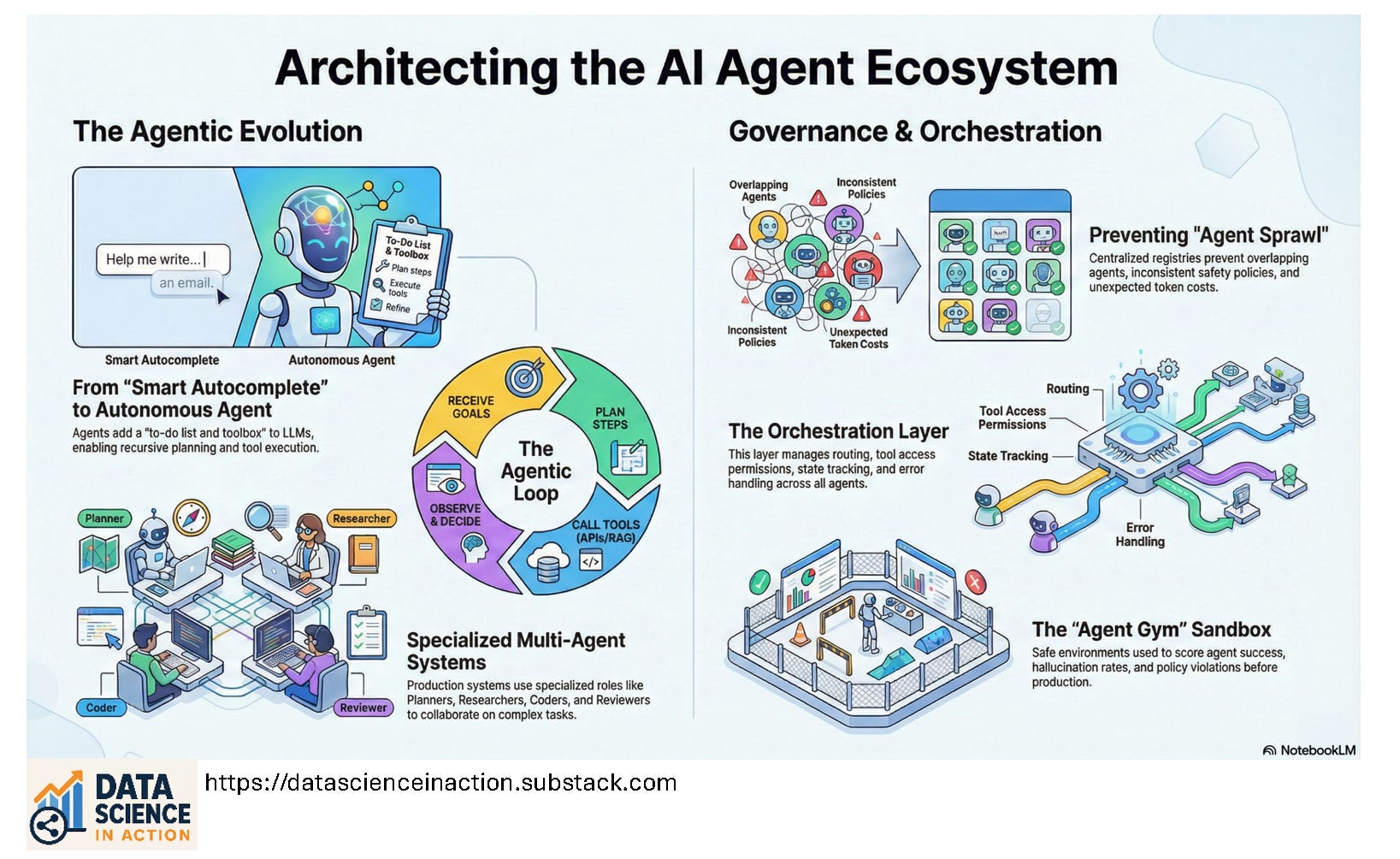
There is no memory beyond the context window for that call, no tools, and no plan. In contrast, an AI agent wraps the model in a loop:
Receive a goal or task.
Plan one or more steps to achieve it.
Call tools (APIs, RAG, code) as needed.
Observe the results.
Decide what to do next until the goal is done or the agent stops.
The model is no longer just predicting the next token in a single response; it is repeatedly choosing the next action in a sequence of steps.
A very simple mental model is:
LLM alone → “smart autocomplete.”
LLM as agent → “smart autocomplete plus a to‑do list and a toolbox.”
2. Agentic AI and multi‑agent systems
The term agentic AI usually refers to systems that fully embrace this pattern: LLMs augmented with memory, tools, and orchestration, often with multiple agents collaborating.
Some common patterns:
Single agent
One agent plans and executes all steps. Suitable for constrained tasks such as “clean this dataset, run basic EDA, and summarize the results.”Multi‑agent system
Several agents with specialized roles. Examples:Planner agent: breaks a large goal into sub‑tasks.
Research agent: calls RAG or web search.
Coder agent: writes or modifies code.
Reviewer agent: critiques and fixes outputs.
Human‑in‑the‑loop agentic flows
Agents propose plans, but certain actions require human approval or asking humans more questions, especially for high‑impact or irreversible changes.
Production systems increasingly use multi‑agent orchestration, in which agents hand off work and negotiate responsibilities, rather than relying on a single “do‑everything” bot.
3. Tools, RAG, and the orchestration layer
In earlier parts, RAG was presented as a pattern: embed, retrieve, and feed context into the LLM. In agentic systems, RAG becomes one tool among many that an agent can choose to use.
Typical tools an agent might have:
RAG query: retrieve relevant company docs.
Database query: run a SQL statement.
File I/O: read or write to a file store.
External APIs: ticketing systems, CRM, cloud services.
Code execution: run a Python snippet or notebook cell.
The orchestration layer coordinates all of this.
Responsibilities of orchestration include:
Routing: deciding which model or agent to call for each step.
Tool access: enforcing which tools each agent is allowed to use.
State management: tracking the conversation, intermediate results, and task state.
Error handling: retries, fallbacks, and safe failure modes.
Logging and observability: capturing traces of every step, tool call, and decision.
Platforms such as LangChain’s LangSmith and AgentOps focus specifically on tracing and debugging agent behavior at this orchestration level.
4. Agent sprawl and why governance matters
As soon as agents become easy to create, agent sprawl appears.
Symptoms of agent sprawl:
Many overlapping agents with similar goals but different prompts or tools.
No central registry: teams do not know which agents exist or what they can do.
Inconsistent policies around data access, safety guardrails, and logging.
Surprises in cost reports because agents are calling large models in loops.
To avoid this, organizations are treating agents as first‑class assets that require governance, not just code review.
Key elements of agent governance:
Registration and cataloging
A central place where each agent is described: purpose, owners, capabilities, risk level, and allowed tools.arionresearch+1Access control
Role‑based permissions for:Which users can invoke which agents?
Which data sources and tools are each agent allowed to access?
Policies and constraints
Rules for:Maximum depth or length of autonomous runs.
Actions that always require human approval.
Topics or data types that are off‑limits.
Audit and explainability
Traces that show:Which agent did what, when, and why?
Which tools were called, and with which parameters?
How the agent’s reasoning unfolded across steps.
Some organizations formalize this into Agent Governance Boards or similar structures that combine technical, risk, and ethics perspectives.
5. Observability and “agent gyms”
Traditional monitoring (latency, errors, CPU utilization) is insufficient for agentic systems. They also need agentic observability: visibility into reasoning chains, tool calls, and interactions among agents.
Modern observability platforms for agents typically offer:
Traces of entire agent runs with all intermediate prompts and outputs.
Tool call logs with arguments and results.
Cost and token usage per run.
Metrics and dashboards for success rates on benchmark tasks.
On top of observability, teams often build agent gyms or sandboxes:
Synthetic or historical tasks that agents must perform in a safe environment.
Automatic scoring of:
Task success.
Policy violations.
Hallucination rates.
Cost and latency.
Agent gyms let teams iterate on prompts, tool sets, and orchestration strategies before granting agents live access to production data or user‑facing systems.

6. A simple mental map for agents in the wild
The following table connects the main “agentic” terms to concrete questions that a practitioner might ask when designing or reviewing a system.
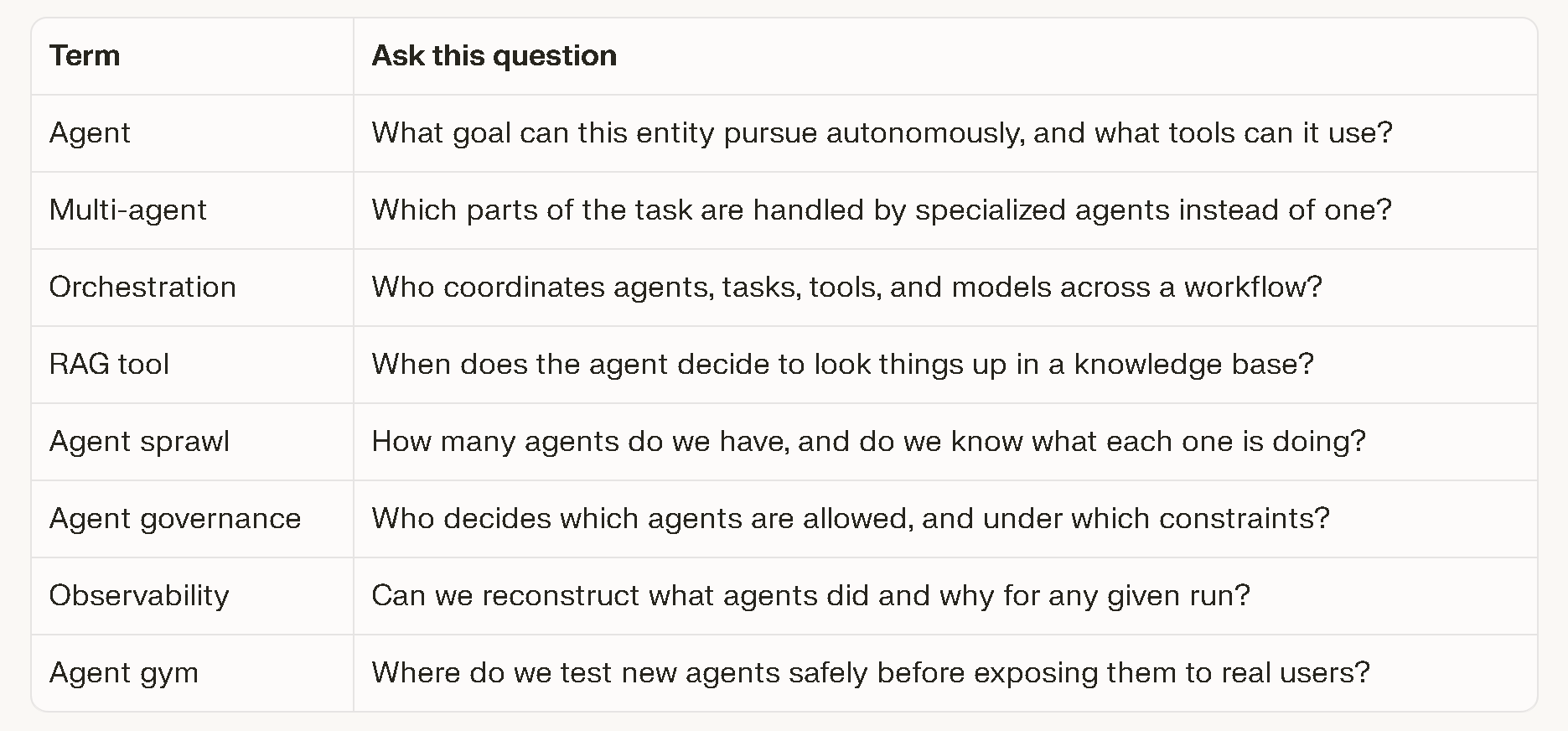
This map connects naturally to the topics of LLMOps, evaluation, and risk management that will appear in later parts of the series.
References
https://www.concentrix.com/services-solutions/agentic-ai/
https://www.covasant.com/blogs/mlops-llmops-agentops-the-essential-ai-pipeline-guide
https://agenta.ai/blog/top-llm-observability-platforms
https://evoluteiq.com/blog_post/5-agentic-ai-trends-reshaping-enterprise-automation-in-q4-2025/