
What Is AI Governance?
Why You Should Care Even If You’re Not a Policy Person?

If you’ve been following AI news lately, you’ve probably seen “AI governance” pop up in headlines. The EU AI Act. Executive orders. Companies are publishing their “responsible AI principles.” It sounds like something for lawyers and regulators, not for someone who’s just learning data science or building AI tools.
But here’s what I’ve come to realize after working in this space: AI governance is not just a policy topic. It’s a practical one. And the sooner you understand what it actually means, the better decisions you’ll make as someone who builds with, uses, or recommends AI systems.
Let’s break it down, with no jargon left unexplained.
What AI Governance Actually Means?
AI governance is the set of rules, processes, and accountability structures that decide how AI is developed, deployed, and used, and by whom, and for what purposes.
Think of it like this: imagine a city with no traffic laws. Cars can go wherever they want, as fast as they want. That’s efficient until it isn’t. People get hurt. Trust breaks down. Governance is the traffic system: the lights, the speed limits, the lanes, the rules for who has the right of way.
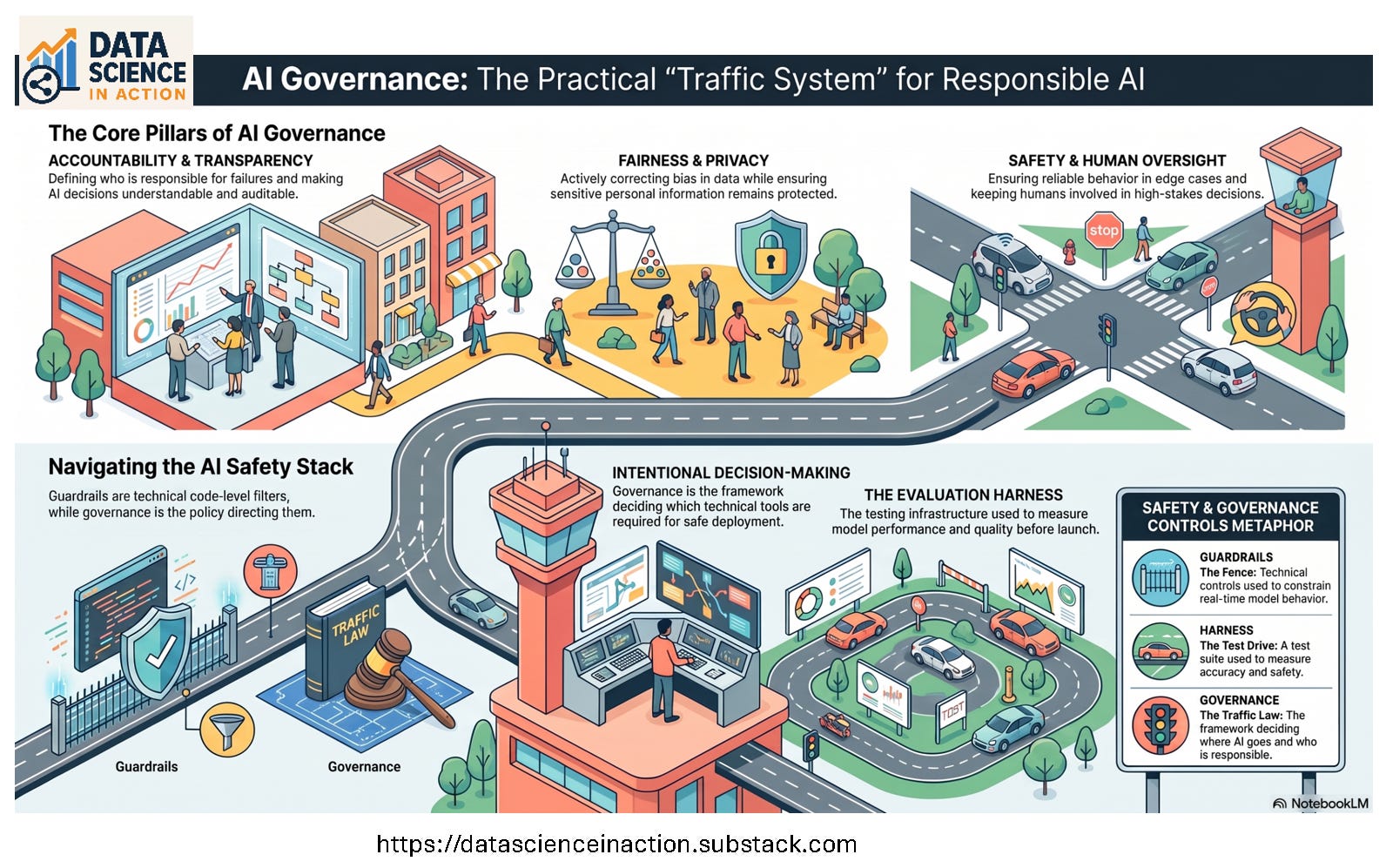
AI governance works the same way. It asks questions like:
Who is responsible when an AI system makes a harmful decision?
What data is allowed to train a model, and what’s off limits?
How do we make sure an AI system treats all users fairly, regardless of their background?
How do we audit whether an AI system is doing what we say it’s doing?
What happens when something goes wrong?
These aren’t abstract philosophical questions. They’re design decisions that affect real people.
Why This Is Relevant to You Right Now?
You might be thinking: I’m just learning Python. Or I’m just using Claude for work. Why does governance apply to me?
It applies because AI is no longer something that only researchers and tech companies build. You are building with it. When you design a prompt that filters job candidates, or build an AI assistant that answers customer questions, or automate a reporting workflow that your manager trusts, you are making governance decisions whether you realize it or not.
What data are you feeding the model? Who sees the outputs? What happens if the model gets it wrong? Those questions don’t disappear just because you didn’t write them down. Governance is the practice of making decisions intentionally, not by accident.
The Key Pillars of AI Governance
Let’s walk through the main things that AI governance actually covers. Think of these as the building blocks.
1. Accountability
Someone has to be responsible when an AI system fails.
Governance frameworks define who that is: the developer who built the model? The company that deployed it? The user who ran it?
Clear accountability means someone is watching and someone answers for the outcomes.
I always show my machine learning students this video to provoke them to think about the implications of what their models are, to demonstrate what AI governance is, and how crucial it is to be cautious with contracts’ liability terms:
2. Transparency
Can you explain how the AI reached its decision?
A model that says “loan denied” without any explanation is very different from one that says “loan denied because the income-to-debt ratio exceeded our threshold.” Transparency is about making AI decisions understandable and auditable.
I use this exact business problem to teach my students how some machine learning models are easier to visualize their decisions than others, and to communicate the business decision. For this example, I demonstrate how decision tree and random forest models are easier to explain than others.
3. Fairness
Does the system treat different groups of people equitably?
An AI system trained on biased data will produce biased outputs, even if no one intended that. Fairness in governance means actively testing for and correcting those disparities.
For this concept, I usually use the Students for Fair Admissions v. Harvard legal case. https://en.wikipedia.org/wiki/Students_for_Fair_Admissions_v._Harvard
4. Privacy
What data does the model use, and is it protected appropriately?
This pillar covers everything from GDPR compliance to ensuring a customer’s private health records aren’t inadvertently leaked into model training data.
5. Safety and Reliability
Does the system behave safely, especially in edge cases?
Governance here means defining what happens when the model is uncertain, when inputs are unusual, or when the stakes are high.
6. Human Oversight
Who can override, correct, or shut down the AI system?
Governance ensures there’s always a human in the loop for decisions that matter, especially high-stakes ones.

Wait, Is This the Same as Guardrails? Or Harnesses? Or Safety?
This is where beginners get confused, and honestly, the terminology doesn’t help. Let me sort it out for you.
These terms often get used interchangeably, but they live at very different levels of your stack.
Guardrails are the technical controls you build around a model to constrain its behavior. They’re code-level interventions: input filters, output validators, toxicity detectors, prompt injection blockers. If the model starts generating something harmful, a guardrail catches it and stops it, redirects it, or flags it.
I wrote a full breakdown of guardrails in a previous article: if you haven’t read it yet, start there before going deeper on governance: A Practical Guide to AI Guardrails.
A Practical Guide to AI Guardrails

If you’ve been building with LLMs for more than five minutes, you’ve already discovered the uncomfortable truth: these models are powerful, but they’re also unpredictable. They hallucinate. They overshare. They make things up with confidence. They sometimes behave like a brilliant intern who skipped their morning coffee.
Harness (or sometimes “evaluation harness”) refers to the testing and benchmarking infrastructure you use to measure how well a model performs. It’s your test suite for AI. You run the model through thousands of scenarios and measure accuracy, safety, consistency, and quality. It’s a quality assurance tool, not a runtime control.
AI Safety is the research field that asks: can we build AI systems that reliably do what humans intend, even as they become more capable? It’s a broader, often more theoretical discipline that governance draws on, but safety research and governance practice are not the same thing.
AI Governance sits above all of these. It’s the framework that decides: what guardrails do we require? Who runs the harness evaluations, and how often? What does “safe enough to deploy” actually mean for our organization? Governance is the policy and process layer. The others are the tools that governance directs.
A quick way to remember the difference:
Guardrails: the fence on the road
Harness: the test drive before launch
Safety research: the science of how to build better roads
Governance: the law that decides where roads can go, who can drive them, and what happens after an accident
You need all of them. But they are not the same thing.
What Good AI Governance Looks Like in Practice
Governance isn’t just a document on a shelf. When it’s actually working, it shows up in concrete ways:
A company publishes its AI use policy and updates it when the technology changes
A team runs regular bias audits on their models before shipping updates
There’s a clear escalation path when a user reports that the AI behaved unexpectedly
AI outputs in high-stakes contexts (medical, financial, legal) always have a human review step
There’s a log of which version of a model made which decision, so that you can trace back errors
None of that happens automatically. It has to be designed, resourced, and enforced.
Where to Start as a Beginner?
You don’t need to read 400 pages of the EU AI Act to start thinking about governance. Here are three practical habits that will make you a more responsible AI practitioner from day one:
Document your assumptions. When you build a prompt or a workflow, write down what you assume the model will and won’t do. That documentation is the beginning of accountability.
I learned the importance of documentation the hard way. I have plenty of examples from my and my friends’ experiences about that. I can’t emphasize the importance of documentation enough. I always say that I’m a documentation fanatic because documentation can literally save you from prison!
Documentation can save your life from prison! Don’t neglect it!
Test your outputs with edge cases. Don’t just check if the happy path works. What happens when someone inputs something unexpected? What happens when the data is missing or wrong?
Know who the AI decisions affect. Before deploying any AI tool, ask yourself: whose life or work does this touch? And what’s the worst case if it gets it wrong?
Governance starts small. It starts with you asking the right questions before you ship.
In this week's paid tutorial, I walk you through, step by step, how to set up a simple AI governance checklist for your own AI projects using Claude. You’ll end up with a reusable template you can apply to anything you build.
If you want the full tutorial, upgrade to a paid subscription below.
#AIGovernance #DataScience #ResponsibleAI #BeginnerFriendly #DataScienceInAction