
What Is the Difference Between API and MCP?
Why MCP is changing the way AI tools connect to the world?

I was on a call recently with a group of professionals who are just starting to explore AI tools. Someone asked: “I keep hearing API and MCP. Are they the same thing? Which one should I care about?”
That question stopped the room. Because honestly, even people who have been in tech for years mix these two up or skip past MCP entirely because it sounds too new and intimidating.
So today, let’s fix that. No jargon. No prior coding experience required.
First, What Is an API?
API stands for Application Programming Interface.
I know. That’s still a mouthful. Let me give you a better mental image.
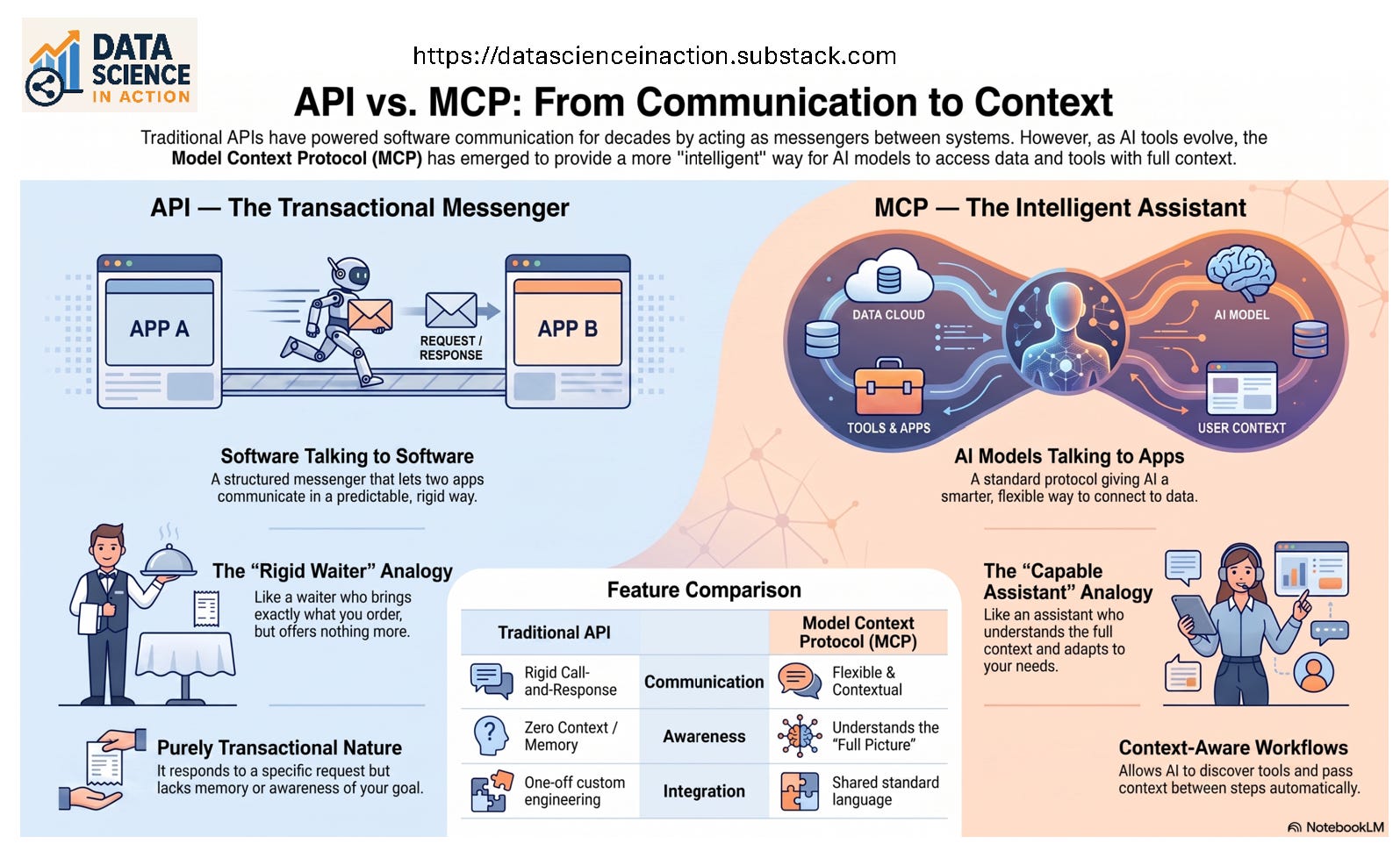
Imagine you’re sitting at a restaurant. You’re the customer. The kitchen is the software or service you want to use. You don’t walk into the kitchen and start cooking yourself. Instead, a waiter takes your order, goes to the kitchen, and brings back exactly what you asked for.
The waiter is the API.
An API is a messenger. It lets two pieces of software communicate in a structured, predictable way. When you use a weather app, it’s calling an API to fetch today’s forecast. When you pay with your card online, there’s an API talking to your bank behind the scenes. When you ask Claude a question through a third-party app, that app is calling Anthropic’s API.
In short: APIs let software talk to other software.
A few things that define a traditional API:
It connects two systems, usually one at a time
You ask for something specific and get a structured answer back
It works based on the rules the developer sets up in advance
It doesn’t know the context of what you’re building, just the request you sent
APIs are incredibly powerful. They’re the backbone of the entire internet as we know it. But they have one limitation worth noting: they are transactional. You call, you get an answer, and that’s it. The API doesn’t remember you. It doesn’t understand your bigger goal. It just responds to the specific request it received.
So, What Is MCP?
MCP stands for Model Context Protocol.
This one is newer, and it was introduced by Anthropic specifically to solve a problem that traditional APIs weren’t designed to handle: giving AI models a smarter, more flexible way to connect to tools and data.
Let’s go back to our restaurant analogy.
With a traditional API, the waiter (the API) takes your exact order and brings exactly that. Nothing more. If you didn’t ask for water, you don’t get water. If you didn’t mention you’re allergic to nuts, the kitchen doesn’t know.
Now imagine a different kind of waiter. One who reads the table, understands the full context of your meal, knows what you’ve ordered before, can suggest the right pairing, and adapts based on how the meal is going. That’s closer to what MCP is doing.
MCP is a standard protocol that allows AI models to connect to external tools and data sources in a way that understands context. Instead of one rigid call and response, MCP allows the AI to:
Discover what tools are available
Understand what each tool does
Call those tools at the right moment during a conversation or task
Pass context between steps so nothing is lost
Think of it this way: an API is like a phone call where you ask one specific question and hang up. MCP is like having a capable assistant who knows the full picture, knows which services to call, and handles the details so you don’t have to.
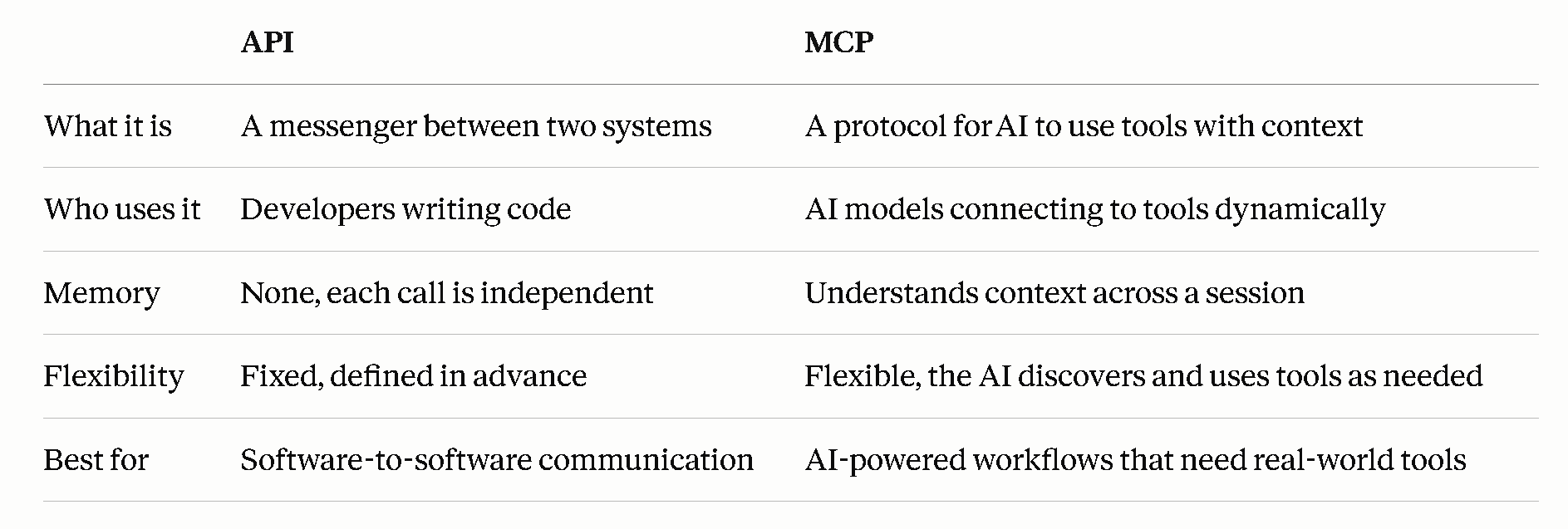
The Key Differences, Side by Side
Why Does This Matter to You?
If you use Claude, ChatGPT, or any AI assistant that connects to tools like your calendar, email, files, or browser, MCP is likely working behind the scenes.
It’s what allows Claude not just to answer a question but also to pull up your document, check your schedule, and write a draft, all in one conversation, without you having to manually copy and paste between apps.
Before MCP, connecting an AI to external tools required extensive custom engineering for each tool. Every integration was a one-off project. MCP provides developers (and AI models themselves) with a shared language, enabling these connections to be built much faster and more reliably.
For you as a beginner, here’s the simplest way to think about it:
API: how apps talk to each other
MCP: how AI models talk to apps, with context and intelligence built in
A Real-World Example
Let’s say you ask an AI assistant: “Can you check my inbox and summarize the emails I received about the project proposal?”
With a traditional API setup, the developer would have had to build a very specific integration: connect to your email service, write code to search for a keyword, pull the results, and feed them to the AI. That’s a custom pipeline built by a developer, one that breaks every time the email service changes something.
With MCP, the AI model itself can connect to a compatible email tool, understand what’s available, run the search, read the results, and summarize them, all within the same conversation. The AI knows the context. It knows you asked about a specific project. It passes that understanding through every step.
That’s the difference between a transactional tool and an intelligent workflow.
Summary
APIs have powered the internet for decades. They are how software systems communicate with each other. They are reliable, structured, and essential.
MCP is what comes next for AI. It’s a new standard that allows AI models to use tools the way a capable assistant would: with awareness of context, flexibility, and the ability to string together multiple steps toward a real goal.
You don’t need to code to benefit from MCP. You just need to understand that when your AI tool connects to your files, calendar, browser, or inbox, there’s a protocol that makes that connection intelligent, not just mechanical.
If you haven’t read my earlier article on AI agents, I highly recommend it as the next step: datascienceinaction.substack.com/p/what-is-the-difference-between-ai. Understanding agents and MCP together will give you a much clearer picture of where AI is heading.
Drop your questions in the comments. I read every single one.
#API #MCP #ModelContextProtocol #AITools #DataScience #ArtificialIntelligence #BeginnerAI #DataScienceInAction #ClaudeAI #AIForEveryone
