
Start Here: Your Complete AI Learning Roadmap from Data Science In Action
Every article you need, in the exact order you need it, from zero AI knowledge to building your own AI systems

If you just subscribed and you’re looking at dozens of articles, wondering where to begin, this one is for you.
I don’t publish in “learn this first, then that” order. I publish as I learn, experiment, and explore. That’s great for the journey, but confusing if you’re brand new and want a structured path from start to finish.
So I built you one.
Below is every Data Science In Action article that belongs in an AI learning roadmap, organized by difficulty level. You don’t have to read them all at once. Start where it feels right. Come back to the earlier ones if something doesn’t click.
Let’s go.
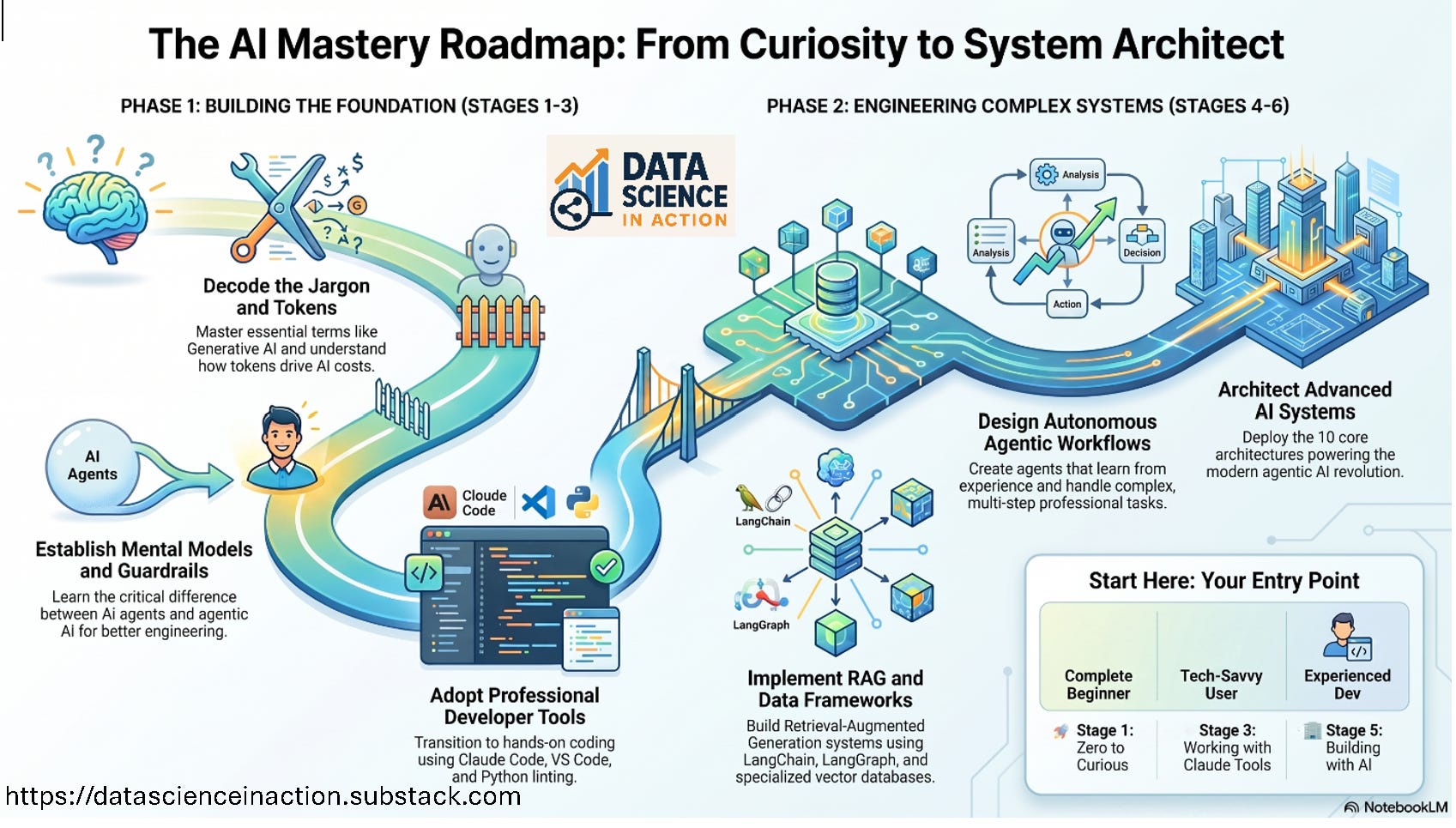
Stage 1: Zero to Curious (Complete Beginner)
No background required. These articles assume you know nothing about AI, and that’s exactly who they were written for.
Part 1: AI Jargon Decoder for Newbies, From “Gen AI” to “Agent Sprawl”
Start here. Generative AI. Large language models. Agent sprawl. These terms are everywhere and almost never explained properly. This is your decoder ring. Read it first and bookmark it; you’ll come back to it.
A Beginner’s Guide to Tokens in Claude
Every time you use an AI tool, you’re using tokens. You’re also spending money on them, even if you don’t realize it yet. This article explains what a token actually is in plain English, why it matters for how AI thinks, and why your usage costs sometimes surprise you.
The Beginner’s Guide to Choosing the Right AI Model (2026 Edition)
Claude, GPT-4, Gemini, Llama. Choosing a model feels overwhelming until you have a framework. This article gives you one, clearly and without the marketing fluff.
Best Zero-Installation Platforms for Teaching AI Pair-Programming
You don’t need to install anything to start coding with AI. This article shows you the best browser-based platforms for real AI pair programming from day one, with no setup required.
How to Use Claude Chrome Extension Without Cowork to Create and Publish Social Media Posts
Your first hands-on AI workflow. This article shows you how to use Claude Chrome to create and publish content directly, no coding, no Cowork required. A great first project for any beginner.
Stage 2: Understanding AI Deeply
You’ve tried AI. Now these articles give you the mental models that separate people who use AI from people who actually understand it.
What is the Difference Between AI Agent and Agentic AI?
You’ve heard both terms. You’ve probably used them interchangeably. They’re not the same thing, and this article explains why in a way that actually sticks. This is the foundation you need before everything in Stage 3 and beyond.
Harnessing AI Models
Once you know which model to pick, this article shows you how to actually get the best out of it. Practical techniques that work across all major AI tools.
A Practical Guide to AI Guardrails
AI is powerful. Unguarded AI is risky. This article explains what guardrails are, why every real-world AI system needs them, and how to design them. Guardrails aren’t magic. They’re engineering.
Karpathy Karpathy Karpathy
Andrej Karpathy co-founded OpenAI, led Tesla's Autopilot team, and now focuses entirely on AI education. This article covers his background, his AI education platform, Eureka Labs, and his latest project: LLM Knowledge Bases, personal wikis that AI builds and maintains automatically from your documents. A fascinating look at where one of the field's sharpest minds thinks AI is heading next.
Stage 3: Working with Claude Tools
You understand AI. Now let’s get hands-on with the specific tools this newsletter covers most deeply.
Claude Code vs GitHub Copilot vs Codex vs Google Colab
So many AI coding tools, so little time. This article compares the four most popular ones head-to-head so you can make an informed decision about which fits your workflow.
Finding Your Claude Code Chat History in VS Code
Your full Claude Code conversation history is sitting on your computer right now, and most people have no idea it’s there. This article shows you exactly where it lives and how to recover it when things go wrong.
Understanding Claude Hooks
Hooks are rules you set once in a JSON file, and Claude follows them automatically, every single time, without you repeating yourself. This article explains what they are and walks you through your first hook in five minutes.
What is Python Lint?
Clean code is faster, cheaper to run with AI, and easier to debug. This article explains what linting is and why it matters, especially when AI is your pair programmer.
How I Automated My Substack Posting
A real, complete AI workflow from start to finish. I walk through exactly how I used Claude to automate the repetitive parts of running this newsletter. A practical model for how to think about automating your own work.
Losing Your Claude Cowork?
If you use Claude Cowork, read this before something goes wrong. This article tells you exactly what to back up and how to recover everything on both Mac and Windows.
I Let Claude Cowork Build an Entire Course for Me. Here Is What Happened
I gave Cowork a course topic, a project folder, and one sample slide. Half a day later, I had a complete course with slides, a transcript, and narrated audio. An honest account of what AI can and can’t do.
Stage 4: Understanding RAG and AI Systems
This is where you go from using AI tools to understanding how AI systems are actually built.
Building a Token-Efficient RAG System for Large Books
RAG is one of the most practical AI patterns in use today. This article shows you how to build a system that lets AI answer questions from a large document without sending the entire document every single time.
Part 2: RAG in Real Life, Embeddings, Vector DBs, and a Colab Notebook You Can Run Today
The hands-on companion to the RAG article above. You’ll compute embeddings, build a tiny in-memory vector store, and call an LLM with retrieved chunks as context. There’s a working Colab notebook. Copy it, paste it, run it.
When to Use Which Vector Database for RAG?
Once you understand RAG, you need to choose a vector database. This article gives you the decision framework, so you stop guessing and start deciding.
Crash Course on LangGraph and LangChain
LangChain and LangGraph are the most popular frameworks for building AI applications. This crash course gets you oriented fast without spending days in documentation.
Which is Better: Building Multiple Agents Using Custom Claude Code Agents, or Using a Framework Like CrewAI?
One of the most practical decisions you’ll face when designing an AI system. This article compares the two approaches so you can choose the right path for your use case.
Stage 5: Building with AI (Intermediate)
You understand the systems. Now let’s build something real.
Agentic Workflows for Beginners: Why They Matter and How They Actually Work
Before you build an agent, you need to understand the workflow it lives in. This article explains what agentic workflows are and what makes them actually work in practice.
How AI Agents Learn from Experience?
Agents that improve over time are the next frontier. This article explains how that actually happens, without the hype, just the mechanics.
Part 4: Agents in the Wild (Agentic AI, Tools, Orchestration, and Governance)
The real building blocks of production agents: tools, orchestration patterns, and governance. The bridge between understanding agents and actually deploying them.
Code Refactoring Explained (For Beginners)
Before you refactor code with AI, you need to understand what refactoring actually means. This article covers the core patterns and why clean code matters even more when AI is your pair programmer.
Claude Code for Devs Part 1: Claude Code Essential MD Files
The markdown files that give Claude Code persistent memory across sessions: PRD, Spec-Kit, Agent Structure, Skills, and Plugins. Plain text files that transform Claude from a chatbot into a structured development partner.

Stage 6: Advanced AI Systems (Build Your Own)
This is where you stop using AI tools and start designing AI systems from scratch.
Beyond the Prompt: The 10 Architectures Powering the Agentic AI Revolution
There are ten established patterns for building AI systems. This article maps them all, so you know what’s possible before you commit to a direction.
Building Your Own Agentic AI System
How to define a use case, design the agent’s tools and memory, and think through the control loop. Agentic AI is assembled piece by piece as capabilities emerge, and this article shows you exactly how.
Claude Code for Devs Part 2: Architecting a To-Do Dashboard Agent
How to architect a real application before writing a single line of code. Planning with AI is a skill in itself, and this article teaches it.
Claude Code for Devs Part 3: Building a To-Do Dashboard Agent, A Complete Project You Can Fork Tonight
Everything from Part 2 implemented. You end up with a working, forkable project you can use as a foundation for your own ideas.
Part 5: Agents in the Wild, A Copy-Paste Colab Lab for Newbies
A working multi-agent system in a Google Colab notebook. Copy it, paste it, run it. This is where everything from the earlier stages comes together in actual running code.
Tutorial: Building Agents That Learn from Experience
A step-by-step tutorial for building an agent that improves over time. One of the most forward-looking tutorials in this newsletter.
Claude Code for Your Development Team: How to Refactor Your Development Team with Agents
For teams, not just individual developers. How to use Claude Code agents to handle refactoring work at scale across an entire codebase, freeing your developers for the work that actually requires human creativity.
A Note on How to Use This Roadmap
You don’t have to read every article. If you’re a complete beginner, start at Stage 1 and work forward. If you already understand AI concepts, jump to Stage 3. If you’re a developer who wants to build, go straight to Stage 5.
Bookmark this page and treat it as your personal curriculum. The articles are not going anywhere.
And if there’s a topic you want covered that isn’t on this list, leave a comment or send me a message. The readers of this newsletter have been driving its direction from the beginning, and that’s not changing.
Welcome to Data Science In Action. You’re in exactly the right place.
#DataScience #AI #AIRoadmap #LearnAI #BeginnerAI #DataScienceInAction #ArtificialIntelligence #MachineLearning #AITools #ClaudeAI #LearningPath